
Prostatic Artery Embolization (PAE)
- Home
- Prostatic Artery Embolization (PAE)
Prostatic Artery Embolization (PAE) is a minimally invasive procedure performed by an interventional radiologist to treat symptoms caused by an enlarged prostate, known as Benign Prostatic Hyperplasia.
Instead of removing prostate tissue through surgery, PAE works by blocking some of the blood supply to the prostate. This causes the prostate to shrink gradually, relieving pressure on the urethra and improving urinary symptoms.
What is Benign Prostatic Hyperplasia (BPH)?
-BPH is a non-cancerous enlargement of the prostate gland that commonly occurs as men age.
Common Symptoms
- Frequent urination
- Urgency to urinate
- Waking up multiple times at night to urinate (nocturia)
- Weak urine stream
- Difficulty starting urination
- Feeling of incomplete bladder emptying
- Urinary retention
Relevant Anatomy:
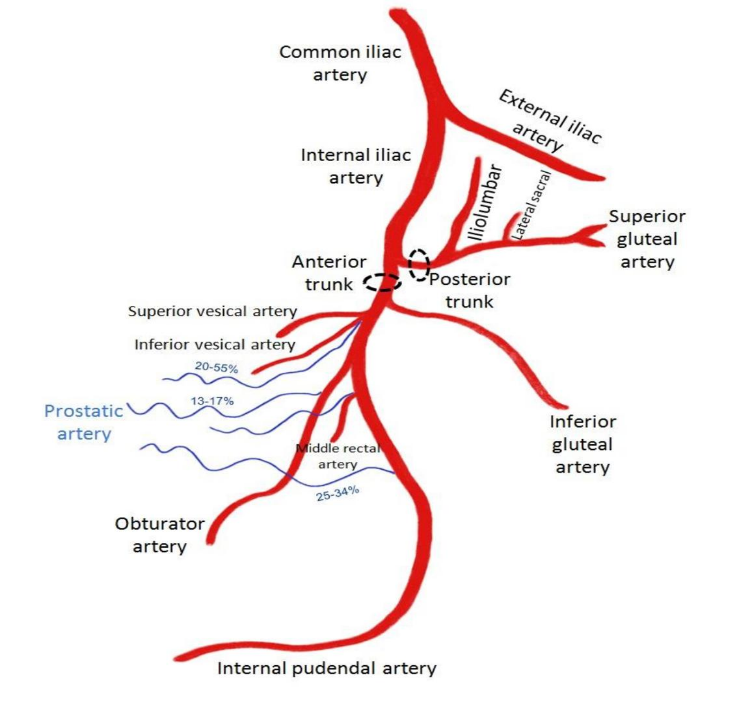
Arteries Involved
The prostatic arteries commonly arise from:
- Internal pudendal artery
- Inferior vesical artery
- Obturator artery
- Internal iliac artery branches
The arterial anatomy is highly variable, making careful angiographic mapping essential.
Structures Nearby
- Prostate gland
- Bladder
- Rectum
- Penis
- Seminal vesicles
Protecting these structures from non-target embolization is one of the most important parts of the procedure.
How Does PAE Work?
The prostate receives blood through the prostatic arteries.
During PAE:
- A tiny catheter is inserted into an artery (usually in the wrist or groin).
- The catheter is navigated to the prostatic arteries using X-ray guidance.
- Tiny embolic particles are injected.
- These particles block blood flow to the enlarged portions of the prostate.
- The prostate gradually shrinks over weeks to months.
As the prostate shrinks:
- Urethral compression decreases.
- Urine flow improves.
- Symptoms become less severe.
INDICATIONS -
Who is a Good Candidate?
PAE may be considered for:
- Men with moderate to severe urinary symptoms due to BPH
- Patients who want to avoid surgery
- Patients who are poor surgical candidates
- Large prostate glands
- Recurrent urinary retention due to BPH
- Men taking blood thinners (in selected cases)
Who May Not Be Suitable?
PAE may not be appropriate if:
- Prostate cancer is suspected
- Active urinary tract infection is present
- Severe atherosclerotic disease prevents catheter access
- Symptoms are caused by another condition
PRE-PROCEDURE EVALUATION
Clinical Assessment
- Medical history
- Physical examination
- International Prostate Symptom Score (IPSS)
Investigations
- PSA level- to rule out prostate cancer
- Urine tests (urine analysis)
- Ultrasound
- MRI (in selected cases)
- CT angiography for vascular mapping
- Uroflowmetry
- Post-void residual urine measurement
STEP-BY-STEP PROCEDURE:
1. Admission– Usually a day care or overnight stay.
2. Anesthesia-
– Most commonly:
- Conscious sedation
- Local anesthesia
- Pain medication
3. Access– A small puncture is made in:
- Radial artery (wrist), or
- Femoral artery (groin)
4. Angiography- Contrast dye is injected to visualize pelvic arteries.
5. Catheterization- A microcatheter is advanced into each prostatic artery.
6. Embolization- Microscopic particles are injected until blood flow slows or stops.
-Common embolic particles include:
- Microspheres
- Polyvinyl alcohol (PVA) particles
- Hydrogel microspheres
7. Bilateral Treatment- Both sides are usually treated.
8. Completion Angiogram– Confirms successful embolization.
9. Recovery- The catheter is removed and pressure is applied.
Duration of the procedure-
Usually 1.5 to 2 hours.
Often performed as a day care procedure.
Most patients go home same day.
Post procedure:
First Few Days-
Mild:
- Pelvic discomfort
- Burning during urination
- Increased urinary frequency
- Fatigue
Return to Activities
- Light activities: 1–2 days
- Normal activities: within several days
BENEFITS OF PAE:
- Minimally Invasive- No major surgical incision, involves lower complication rates, and generally allows faster recovery.
- Symptoms relief- Significantly improves urinary frequency, urgency, and weak stream.
- Preservation of Sexual Function- Lower risk of erectile dysfunction and urinary incontinence compared with many traditional surgical procedures like TURP.
- Reduced Bleeding Risk- Particularly useful for selected high-risk patients
- Short Hospital Stay- Usually outpatient
- Can Treat Large Prostates- Effective even in significantly enlarged glands
POTENTIAL RISKS AND COMPLICATIONS:
Common
- Temporary urinary symptoms
- Mild pelvic pain
- Urinary frequency
- Burning urination
Less Common
- Urinary tract infection
- Blood in urine
- Blood in semen
- Temporary urinary retention
Rare
- Non-target embolization
- Bladder injury
- Rectal injury
- Penile ischemia
- Severe infection
PAE vs Transurethral resection of Prostate TURP
Feature | PAE | TURP |
Incision | No | No external incision, but surgical resection |
Anesthesia | Usually local anesthesia | Often spinal or general anesthesia |
Hospital Stay | Usually same day | Often 1-3 days |
Recovery | Faster | Longer |
Bleeding risk | Lower | Higher |
Sexual side effects | Generally low | Higher risk of retrograde ejaculation |
Tissue removal | No | Yes |
FREQUENTLY ASKED QUESTIONS:
During the Procedure:
1. Is the procedure it painful?
- Most patient experience only mild discomfort, sedation and pain medications are commonly used.
2. Will the prostate disappear?
- No, the prostate shrinks but remains present.
3. Can symptom return?
- Yes, some patients may require additional treatment years later.
4. Is PAE used for prostate cancer?
- PAE is primarily used for BPH and is not a standard treatment for prostate cancer.
5. Does PAE cure BPH?
- No, it treats symptoms by shrinking the prostate and improving urinary flow.
Would you like to request an appointment?
You can call on +91-98200 86520 for Appointments or fill the form below