
DJ Stents (Ureteral Stenting)
- Home
- DJ Stents (Ureteral Stenting)
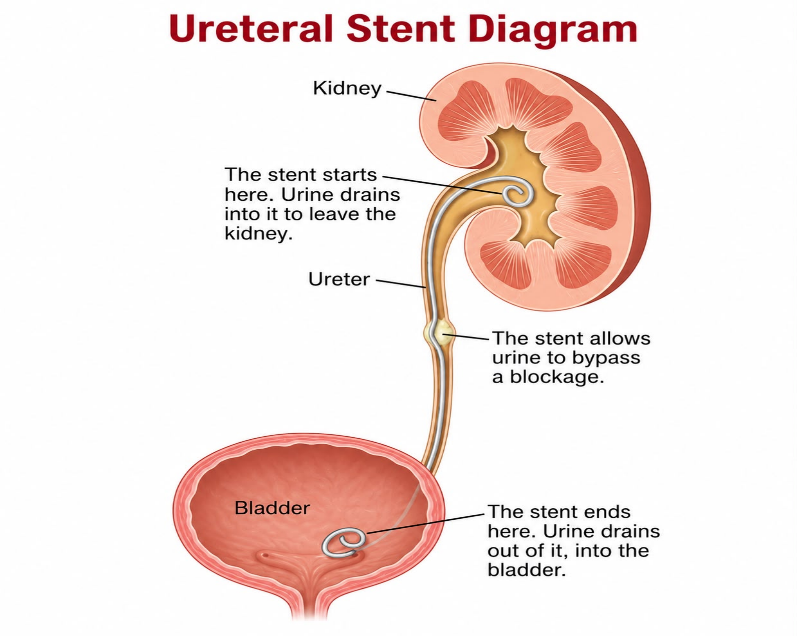
A ureteral stent is a thin, slender, flexible tube inserted into the ureter to prevent or treat blockages in urine flow from the kidney to the bladder. Also known as DJ stenting (double-J stent), this medical device plays a key role in maintaining proper urinary function when natural drainage is compromised.
-It is called a Double J stent because both ends are curled like the letter “J”:
- One end stays in the kidney
- The other end stays in the urinary bladder
-These curled ends prevent the stent from moving out of position.
Why is a DJ Stent Needed?
1. Kidney Stones- A stone may block the ureter and stop urine drainage.
2. Ureteric Obstruction- The ureter may become narrowed due to:
- Scar tissue
- Tumors
- Inflammation
- Previous surgery
3. Infection with Obstruction- If urine is trapped behind a blockage, infection can become serious. A stent helps drain urine quickly.
4. After Stone Removal Procedures
- Ureteroscopy (URS)
- Laser lithotripsy
- PCNL
-A DJ stent may be placed temporarily to keep the ureter open.
5. Injury to the Ureter- After surgery or trauma.
6. Pregnancy- Sometimes a stent is used when a pregnant woman develops severe ureteric obstruction.
Pre-Procedure Evaluation:
Before stent insertion, doctors usually perform:
1. Clinical Assessment- Helps to determine the urgency of treatment
- Symptoms
- Medical history- to plan the procedure safely
- Physical examination
2. Blood Tests-
- Complete blood count (CBC)- WBC, platelet count
- Kidney function tests- Serum Creatinine, eGFR
- Coagulation profile- PT/INR
3. Urine Tests
- Urine routine/ microscopy, urine culture.
- Imaging Tests- Ultrasound, CT scan, X-ray KUB (these tests helps to locate the obstruction and asses the kidney anatomy).
4. Consent-
The patient is informed about the procedure, possible risks, benefits and complications to the patient and relatives by the Interventional Radiologist. Written content is also taken.
5. Fasting- the patient is asked not eat or drink anything 2 hours prior to the procedure.
Procedure of DJ Stenting:
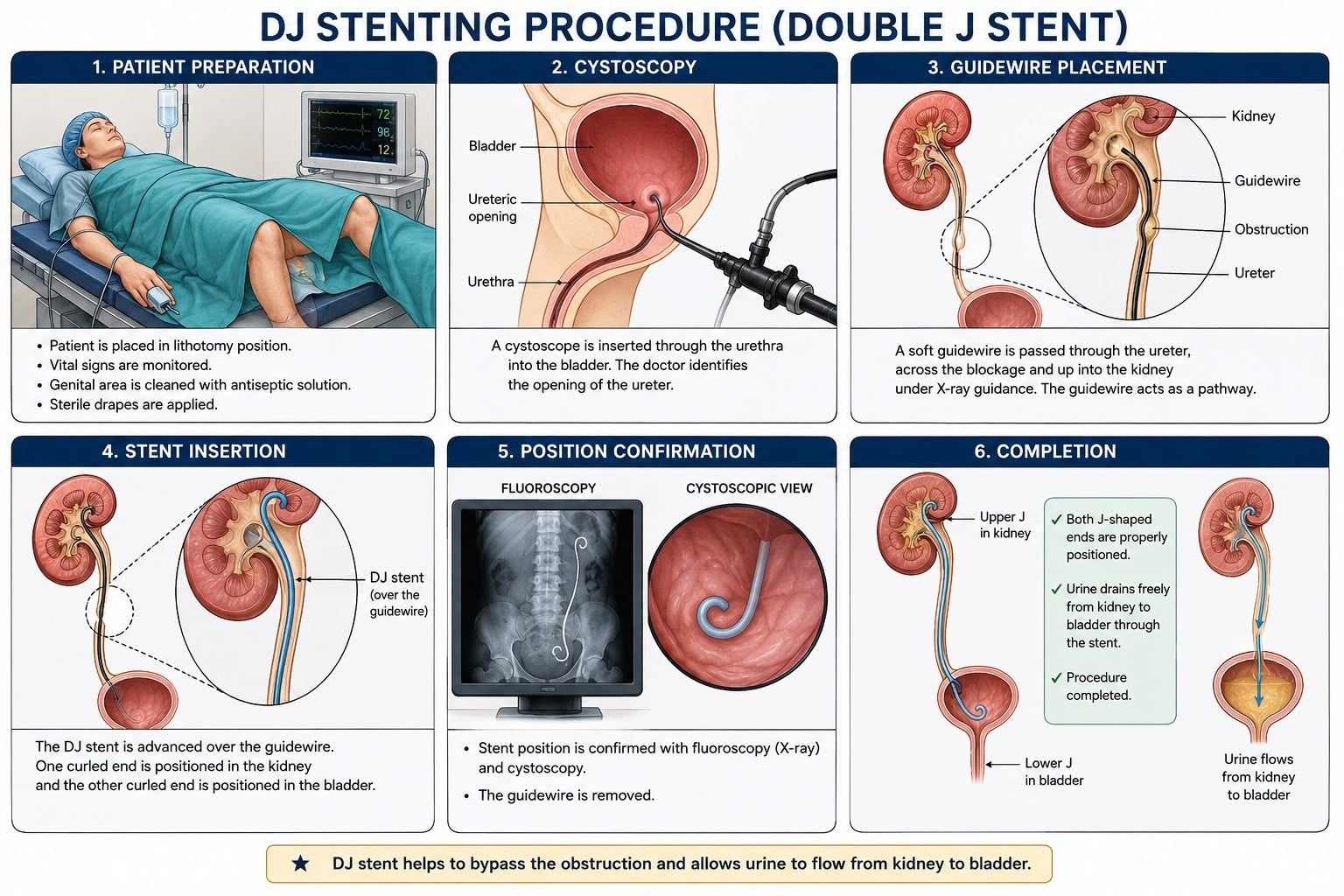
-The patient is positioned on the procedure table, and vital signs such as heart rate, blood pressure, and oxygen saturation are continuously monitored. The genital area is cleaned with an antiseptic solution to reduce the risk of infection, and sterile drapes are applied to maintain a sterile field throughout the procedure. The procedure is done under local anesthesia.
-A thin, flexible camera called a cystoscope is gently inserted through the urethra and advanced into the urinary bladder. The doctor then identifies the opening of the ureter where the stent will be placed.
-A soft guidewire is carefully passed through the ureter, across the site of obstruction, and into the kidney under imaging guidance. The guidewire serves as a pathway for accurate placement of the stent.
-The DJ stent is advanced over the guidewire and positioned within the ureter. One curled end of the stent is placed inside the kidney, while the other curled end is positioned inside the bladder to prevent stent migration.
-The correct position of the stent is confirmed using fluoroscopy (real-time X-ray imaging) and cystoscopy. Once satisfactory placement is achieved, the guidewire is carefully removed.
- The procedure is completed after confirming that both J-shaped ends of the stent are properly positioned and that urine can drain freely from the kidney to the bladder through the stent. The patient is then monitored during recovery before being discharged according to their clinical condition.
Post Procedure Care:
-The patient is monitored for:
- Pain
- Bleeding
- Fever
- Urine output
Most patients go home: Same day or next day.
Advantages of DJ Stenting:
- Relieves urinary obstruction
- Protects kidney function
- Helps infected urine drain
- Minimally invasive
- Quick recovery
- Prevents kidney damage
Possible Complications:
Although generally safe, complications can occur.
–Early Complications :
- Pain, fever, hematuria (blood in urine), urinary tract infection (UTI), bladder irritation.
— Late Complications :
- Stent migration (stent moves from its original position)
- Stent blockage
- Stent encrustation (Mineral deposits form on the stent)
- Stone formation on stent
- Stent fracture- Rare.
How Long Can a DJ Stent Stay?
-This depends on the type of stent.
- Temporary Stent- Usually 2–6 weeks
- Long-Term Stent- Can remain for several months
-However, regular follow-up is essential.
DJ Stent Removal:
-Removal is usually simple.
Procedure:
- A cystoscope is inserted into the bladder.
- The stent is identified.
- Special forceps grasp the stent.
- The stent is gently removed.
-The procedure usually takes 5–10 minutes. Most patients go home shortly afterward.
When Should You Contact a Doctor?
-Seek medical attention if you develop:
- High fever
- Severe pain
- Inability to pass urine
- Heavy bleeding in urine
- Persistent vomiting
- Severe burning during urination
Short Summary:
- A DJ stent is a tube placed between the kidney and bladder.
- It helps urine bypass a blockage.
- Commonly used for kidney stones, ureteric obstruction, and infections.
- Placement is minimally invasive and usually done through a cystoscope. Under a radiology suit(cath lab) by an Interventional Radiologist.
- Temporary urinary symptoms are common after insertion.
- Stents should never be forgotten and must be removed or changed on time.
Would you like to request an appointment?
You can call on +91-98200 86520 for Appointments or fill the form below