
Central Venous Obstruction Angiography / Stenting
- Home
- Central Venous Obstruction Angiography / Stenting
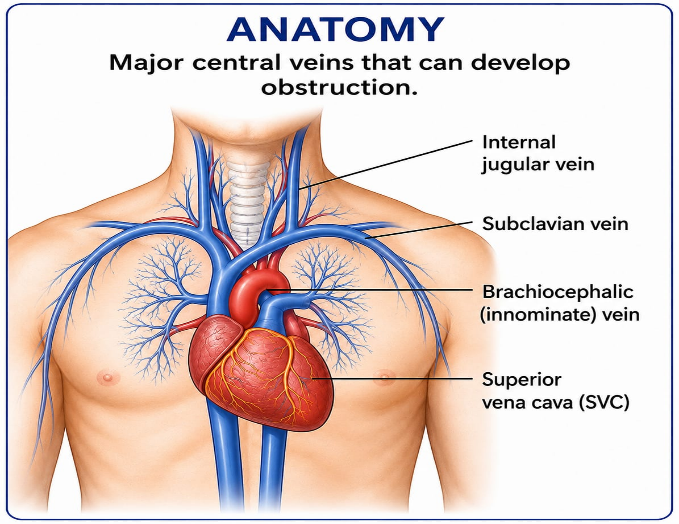
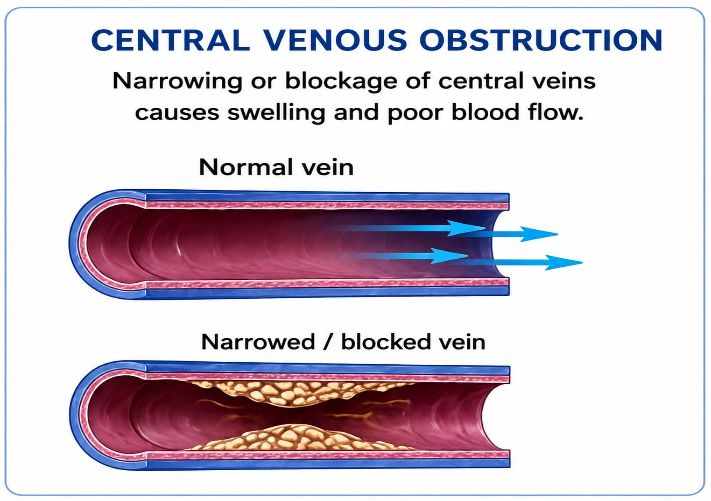
-Central venous obstruction (CVO) means narrowing (stenosis) or blockage (occlusion) of the large veins that carry blood from the arms, neck, and upper chest back to the heart.
The commonly affected veins are:
- Internal jugular vein
- Subclavian vein
- Brachiocephalic (innominate) vein
- Superior vena cava (SVC)
This condition is commonly seen in patients who have:
- Hemodialysis catheters
- Pacemaker wires
- Central venous catheters
- Previous venous thrombosis (blood clot)
Why Does It Occur?
-Repeated irritation of the vein wall can cause:
- Inflammation
- Scar tissue formation
- Narrowing of the vein
- Complete blockage in severe cases
Signs and Symptoms of Central Venous Obstruction:
Patients may experience:
- Swelling of the arm
- Swelling of the face or neck
- Prominent chest wall veins
- Pain or heaviness in the arm
- Difficulty using dialysis fistula
- Increased venous pressures during dialysis
- Reduced dialysis efficiency
What is Angioplasty and Stenting?
Angioplasty is a minimally invasive procedure in which a balloon is inflated inside the narrowed vein to widen it.
Stenting involves placing a small metal mesh tube (stent) inside the vein to keep it open if angioplasty alone is not enough.
-Stenting is usually performed when:
Balloon angioplasty alone is unsuccessful
- Narrowing recurs quickly
- Significant elastic recoil occurs after angioplasty
Why is it Done?
The procedure is performed to:
- Relieve arm, face, or neck swelling
- Improve dialysis fistula or graft function
- Reduce venous pressure
- Improve blood flow
- Treat recurrent narrowing
- Improve quality of life
Common Causes:
- Previous dialysis catheters
- Long-term central venous catheters
- Pacemaker or defibrillator leads
- Previous central venous procedures
- Repeated vein injury
- Blood clots (thrombosis)
- Scar tissue formation
Contraindications:
The procedure may not be suitable if there is:
- Active infection
- Severe uncontrolled bleeding disorder
- Untreated allergy to contrast dye
- Severe medical instability
Pre-Procedure Evaluation:
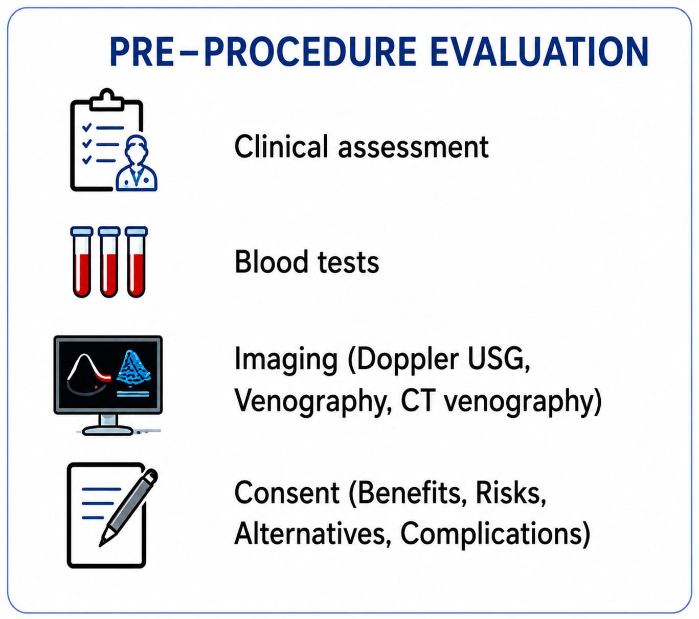
- Clinical Assessment – The doctor reviews your symptoms, medical history, dialysis access, previous catheter placements, current medications, and any allergies to ensure the procedure is safe.
- Blood Tests – Blood tests such as CBC, kidney function tests, PT/INR, aPTT, platelet count, and blood sugar (if needed) are performed to check your overall health and bleeding risk.
- Imaging – Imaging tests like Doppler ultrasound, venography, and sometimes CT venography help locate and assess the severity of the vein narrowing or blockage.
- Consent – The doctor explains the procedure, its benefits, possible risks, alternative treatment options, and potential complications before obtaining your consent.
Patient Preparation:
- Fasting for 2 hours (as advised)
- Continue or stop medications as instructed
- IV line placement
- Vital signs checked
Procedure of central venous obstruction angioplasty/ stenting:
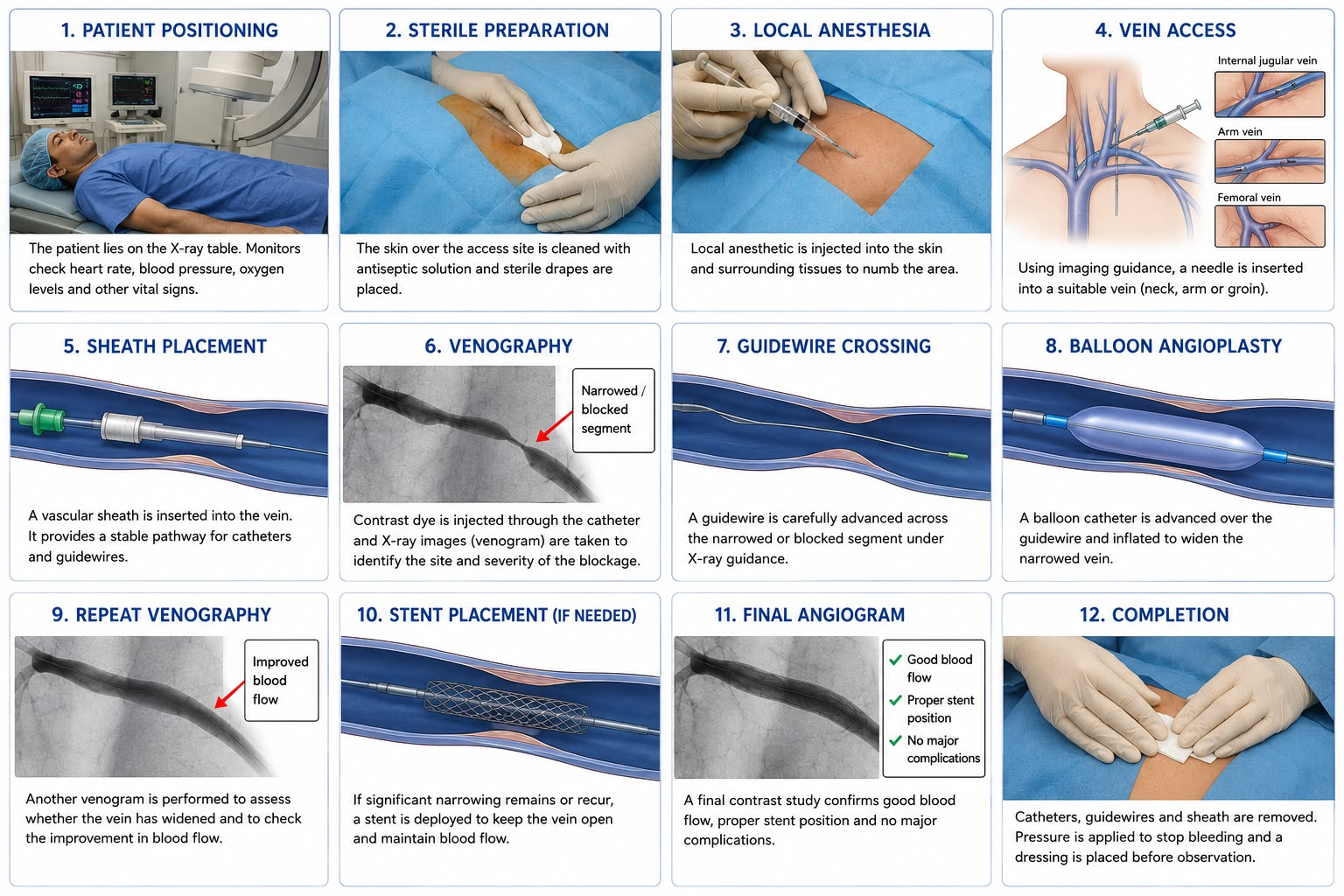
The patient lies in supine position (on back) on the X-ray table heart rate, blood pressure, and oxygen levels are monitored.
The skin is cleaned with antiseptic solution and sterile drapes are placed.
Local anesthetic is injected to numb the skin over the decided puncture site.
A needle is inserted into a suitable vein, usually:
- Femoral vein (groin)
- Internal jugular vein
- Arm vein
-A vascular sheath, which is a short and hollow tube, is inserted into the vein.This provides stable pathway for introducing a guide wire or catheters.
A contrast dye is injected to identify the site and severity of narrowed or the blocked vein.
A thin, flexible guidewire is carefully passed across the narrowed or blocked segment under X-ray guidance
A balloon catheter is advanced over the guidewire to the narrowed area. The balloon is inflated for several seconds to compress the narrowed tissue against the vein wall, widening the vein and improving the blood flow.
After angioplasty, another venogram is performed to check whether the vein has widened adequately and to assess the improvement in blood flow.
If significant narrowing remains or recurs after angioplasty, a a metal mesh stent is deployed across the affected segment. To keep the vein open and maintain long-term blood flow.
A final contrast study confirms:
- Good blood flow
- Proper stent position
- No major complications
All the catheters, guidewires and sheath are removed. Pressure is applied to the puncture site to stop bleeding, and a tight dressing is placed.
During the Procedure:
The patient may feel:
- Mild needle prick from local anesthesia
- Warm sensation from contrast injection
- Mild pressure during balloon inflation
-The procedure is generally well tolerated
Post-Procedure Care:
After the procedure:
-Observation for several hours
- Monitoring of blood pressure and pulse
- Puncture site checked for bleeding
- Adequate hydration encouraged
- Dialysis access evaluated
-Most patients can return home the same day or the following day.
Advantages of Central Venous Angioplasty/ Stenting
- Relieves arm and facial swelling
- Improves blood flow
- Preserves dialysis access
- Improves dialysis efficiency
- Minimally invasive
- Faster recovery than surgery
Possible Complications
Although uncommon, complications may include:
Minor Complications
- Pain at puncture site
- Bruising
- Small hematoma
Major Complications
- Bleeding
- Infection
- Vein rupture
- Stent migration
- Re-thrombosis
- Contrast allergy
- Pulmonary embolism (rare)
Would you like to request an appointment?
You can call on +91-98200 86520 for Appointments or fill the form below